Understanding purchase triggers, product evaluation and retail preferences
Every appliance purchase begins with a need. It may be a first-time purchase, the replacement of an ageing product, an upgrade to better technology or the addition of another appliance to the household. Identifying the need is only the beginning. Consumers must then evaluate products, compare brands, assess prices and decide where to buy.
The appliance purchase journey connects household requirements with product research, brand choices and retail experiences. Understanding these connections helps brands and retailers respond to what consumers value when making a purchase.
The Purchase Journey Begins With a Need
First-time purchases and replacements are the leading reasons consumers consider buying an appliance. Together, they account for nearly two-thirds of the main reasons for considering an appliance.
Additional purchases and technology upgrades also contribute to demand, while moving into a new home accounts for a smaller share.
These purchase situations create different expectations. First-time buyers need to understand the category and identify the right product, while replacement buyers may already have experience with a particular brand or product. Additional purchases and upgrades bring their own requirements around capacity, features and performance.
Recognising the purpose behind a purchase is the starting point for a more relevant consumer experience.
Research Shapes the Shortlist
Consumers approach appliance shopping with a clear set of information needs. Product features, customer reviews and brand comparisons lead the research checklist, with price also playing a prominent role.
Offers and discounts, warranty and EMI options contribute to the evaluation process, while after-sales service and energy efficiency also enter the decision.
Consumers want to understand what a product offers, how it compares with alternatives and whether its benefits justify the price. Clear product information and credible customer feedback help brands build confidence before shoppers enter the store.
Quality, Price and Features Lead the Evaluation
Product quality, better price and better features are the leading benefits consumers seek when choosing an appliance.
The same priorities shape consumer concerns. Product quality, affordability and electricity consumption are among the most prominent considerations.
Consumers want appliances that deliver reliable performance, useful features and value for money. The cost of running and maintaining a product also matters.
A strong product proposition must therefore connect performance and features with affordability and long-term value.
Brand Decisions Often Begin Before the Store Visit
Most surveyed shoppers have already decided on a brand before visiting the store. Only a smaller share enter without a pre-decided brand.
Brand consideration often begins before the physical shopping experience. Advertising, product research, customer feedback and previous experience can all contribute to the shortlist consumers carry into a store.
However, a preferred brand does not guarantee a purchase of the preferred product. When the preferred brand or model is unavailable, shoppers may visit another chain store, choose an alternative brand or consider another model from the same brand.
Availability plays a direct role in converting consumer preference into a purchase. Retailers need to maintain access to preferred products while helping shoppers evaluate suitable alternatives when
their first choice is unavailable.
Why the Physical Store Still Matters
Physical stores remain an important part of the appliance decision journey.
Product comparison, physical product experience and demonstrations are among the leading reasons consumers visit a store. Immediate availability, greater trust, better EMI options and installation support also contribute to the appeal of physical retail.
The store provides an opportunity to evaluate products in person, understand differences between models and seek advice before making a decision.
For retailers, the opportunity lies in making these interactions useful and informative, helping consumers move from product interest to purchase confidence.
Chain Stores Lead Store Preference
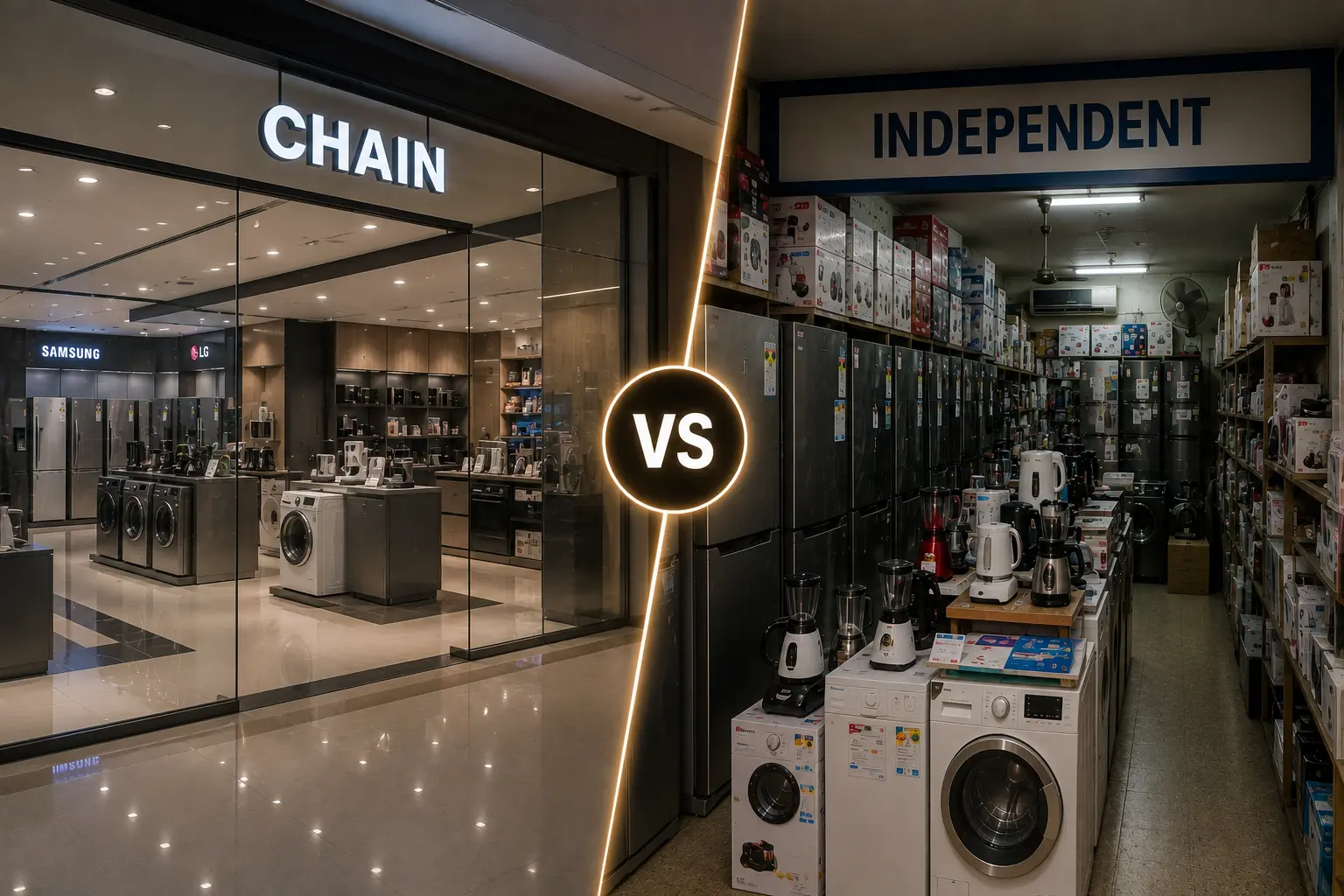
When the product and price are the same, chain stores are the clear preference among surveyed consumers.
Easier product comparison, a wider product range and better product advice are among the leading reasons for this preference. Greater trust, after-sales support, exchange offers and EMI options also contribute.
Independent stores offer a different form of value. Trust built through past experience and personal relationships with the owner or manager can influence consumer preference.
Retail choice is shaped by the experience and support consumers expect from a store, rather than price alone. Chain stores create value through comparison, range and advice, while personal relationships remain an important part of the independent-store experience.
Brand Preferences Vary Across Appliance Categories
Consumer brand preferences differ across appliance categories. Product features, quality and reliability recur as important considerations, but their relative importance changes by product type.
LG and Samsung feature prominently in refrigerators and washing machines, while Daikin appears among the leading air-conditioning brands. Pigeon features prominently in cooking appliances.
A brand’s overall presence does not necessarily translate into the same level of preference across every appliance category.
Category-specific positioning helps brands communicate the attributes consumers value in individual product types. Retailers also benefit from category-level knowledge, enabling more relevant product comparisons and recommendations.
Connecting Consumer Needs With Retail Confidence
The appliance purchase journey connects household needs with product research, brand decisions and the retail experience.
Consumers look for quality, useful features and value, while also considering price, running costs and product reliability. They often arrive with a brand already in mind, but availability and the in-store experience can still influence the final decision.
Retailers can respond by understanding the purpose behind a purchase, making product differences easier to evaluate and offering suitable alternatives when preferred products are unavailable.
Brands can strengthen their position through clear product communication, consumer confidence and effective retailer support.
Appliance retail success depends on connecting consumer needs with the right product, the right information and a confident purchase experience.
Authors
Vikas Sahoo – Manager, Research & Operations
Vikas Sahoo leads Research & Operations at Le Soleil Enterprises (LSE India), overseeing market intelligence and consulting engagements across diverse industries. He specializes in transforming data into actionable insights that enable businesses to strengthen customer understanding, improve performance, and make informed decisions.
Vikas can be reached at vikas@lse-india.com
Yash Bhise – Business and Data Analyst
Yash Bhise plays a key role in delivering market intelligence and business consulting projects at Le Soleil Enterprises (LSE India). His experience spans customer experience measurement, retail and distribution analytics, competitive benchmarking, and strategic reporting, helping organizations identify growth opportunities, improve performance, and make informed business decisions.
Yash can be reached at yash@lse-india.com
Disclaimer
This report has been prepared by Le Soleil Enterprises (“LSE”) for general informational and knowledge purposes only. It is based on information, data and sources considered relevant and available to LSE at the time of preparation. While reasonable care has been taken to ensure the quality and reliability of the information presented, LSE does not warrant or represent that the information is complete, accurate, current or free from error or omission.
The findings, estimates, observations and views presented in this report are intended to provide general market and business insights and should not be construed as professional, financial, investment, legal, tax, commercial or other advice, nor should they be regarded as a recommendation or endorsement of any particular course of action.
The information contained in this report may be subject to change as market conditions, business environments, data availability and other relevant factors evolve. Users should undertake their own assessment, validation and due diligence before relying on any information contained herein or making any business, financial, investment or other decision.
LSE shall not be responsible or liable for any loss, damage, cost, expense or other consequence, whether direct, indirect, incidental, consequential or otherwise, arising from or in connection with the use of, reliance upon, or decisions or actions taken on the basis of this report or any information contained herein, to the maximum extent permitted by applicable law.
By accessing or using this report, the user acknowledges that the information is provided on an “as is” basis and accepts responsibility for determining the appropriateness and suitability of the information for their particular circumstances.
More Research & Insights

How Mumbai Shops for Home Appliances
A Consumer Study of Purchase Triggers, Product Evaluation and Retail...
Read More
The Indian Fabric Market
Understanding Consumer Shifts, Retailer Realities, and the Rise of Premium...
Read More
India Jewellery Market Intelligence
Understanding Consumer Demand, Organised Retail and Changing Industry Dynamics
Read More