LSE White Goods Retail Intelligence Series
Volume 1
Inside Mumbai's White Goods Retail Market
July 3, 2026
Inside Mumbai’s White Goods Retail Market
This inaugural edition of the LSE White Goods Retail Intelligence Series, titled Inside Mumbai’s White Goods Retail Market, presents an operational assessment of Mumbai’s organised white goods retail landscape. Developed using Le Soleil Enterprises’ retail audit methodology, the study examines product availability, brand representation, retailer confidence and merchandising practices across leading retail outlets. By establishing a comprehensive view of the market, this edition provides the foundation for understanding the operational dynamics, retail priorities and competitive landscape that shape Mumbai’s white goods industry.
Where Consumer Demand Meets Retailer Confidence
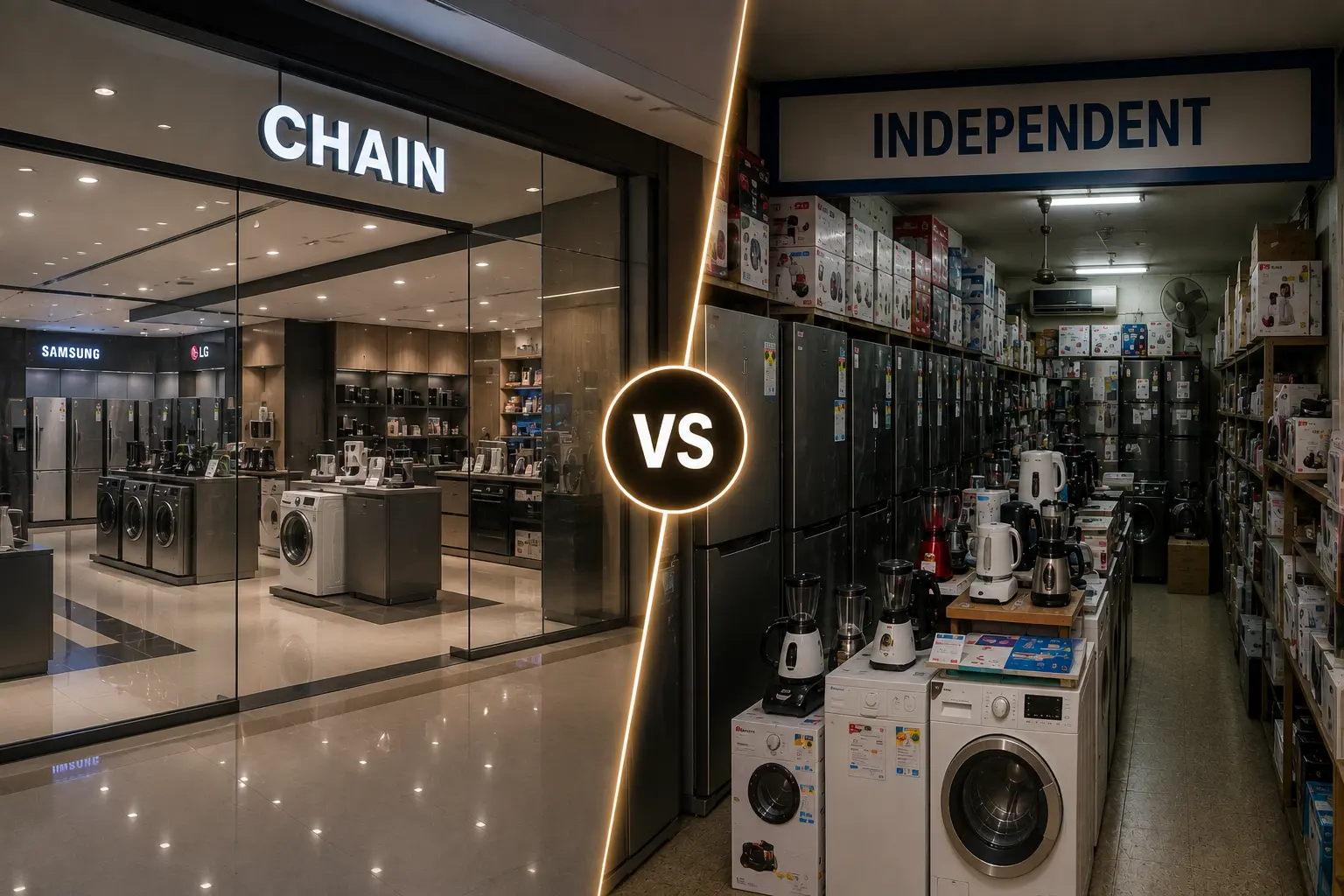
Walk into any electronics store in Mumbai and you’ll notice something that rarely changes. Despite new product launches, evolving technologies and increasing consumer choice, a familiar set of brands continues to dominate retailer shelves across the city’s white goods market. That consistency isn’t accidental. Every appliance on display has earned its place through a combination of consumer demand, retailer confidence and commercial viability. The real story isn’t simply which brands are winning, but why they continue to secure valuable shelf space while others struggle to build lasting retail presence.
The Categories That Define the Market
Core Categories Drive Everyday Retail
Some product categories have become indispensable to modern retail. Refrigerators, washing machines and air conditioners continue to anchor retailer assortments, while cooking appliances have steadily strengthened their presence as part of the everyday household basket. Together, these four categories form the backbone of Mumbai’s white goods market, representing the products retailers simply cannot afford to be without.
Leadership Is Built Within Every Category
At first glance, market leadership appears remarkably stable. LG continues to lead refrigerators, Daikin dominates air conditioners, Samsung maintains the strongest position in washing machines, while Pigeon has established itself as the leading cooking appliance brand. Yet beneath these familiar leaders lies a more competitive reality, where product formats, consumer expectations and category specific preferences continue to shape how brands compete within every segment of the white goods market.
The Retailers Behind Every Stocking Decision
Retail Decisions Begin with Consumer Demand
Shelf space has become one of retail’s most valuable assets, and products rarely earn it by chance. Consumer demand remains the strongest influence on stocking decisions, closely followed by profit margins and brand reputation. Advertisements, distributors and company sales representatives continue to be the primary channels through which retailers discover new products, highlighting that success in the white goods market depends not only on consumer preference but also on sustained visibility and strong retail engagement.
Confidence Extends Beyond Availability
The strongest brands don’t simply appear in more stores, they earn lasting retailer confidence. Preference, experience and recommendation move closely together, creating an advantage that extends well beyond product availability. Samsung consistently leads across retailer preference, stocking priority, experience and customer preference, while LG follows closely behind, illustrating that once retailer confidence is established, it becomes one of the most durable competitive advantages a brand can build.
The Road to Lasting Leadership
Mumbai’s white goods market reflects a mature and highly competitive retail ecosystem where established leaders continue to strengthen their positions, not because competition has slowed, but because earning retailer confidence has become increasingly difficult. Consumer expectations continue to evolve, product formats continue to diversify, and every square foot of showroom space has become more competitive than ever. In a market where every stocking decision carries commercial significance, the brands that consistently combine consumer relevance, retailer trust and sustained market presence will continue to shape the future of Mumbai’s white goods market.
Authors
Vikas Sahoo – Manager, Research & Operations
Vikas Sahoo leads Research & Operations at Le Soleil Enterprises (LSE India), overseeing market intelligence and consulting engagements across diverse industries. He specializes in transforming data into actionable insights that enable businesses to strengthen customer understanding, improve performance, and make informed decisions.
Vikas can be reached at vikas@lse-india.com
Yash Bhise – Business and Data Analyst
Yash Bhise plays a key role in delivering market intelligence and business consulting projects at Le Soleil Enterprises (LSE India). His experience spans customer experience measurement, retail and distribution analytics, competitive benchmarking, and strategic reporting, helping organizations identify growth opportunities, improve performance, and make informed business decisions.
Yash can be reached at yash@lse-india.com
Disclaimer
This report has been prepared by Le Soleil Enterprises (“LSE”) for general informational and knowledge purposes only. It is based on information, data and sources considered relevant and available to LSE at the time of preparation. While reasonable care has been taken to ensure the quality and reliability of the information presented, LSE does not warrant or represent that the information is complete, accurate, current or free from error or omission.
The findings, estimates, observations and views presented in this report are intended to provide general market and business insights and should not be construed as professional, financial, investment, legal, tax, commercial or other advice, nor should they be regarded as a recommendation or endorsement of any particular course of action.
The information contained in this report may be subject to change as market conditions, business environments, data availability and other relevant factors evolve. Users should undertake their own assessment, validation and due diligence before relying on any information contained herein or making any business, financial, investment or other decision.
LSE shall not be responsible or liable for any loss, damage, cost, expense or other consequence, whether direct, indirect, incidental, consequential or otherwise, arising from or in connection with the use of, reliance upon, or decisions or actions taken on the basis of this report or any information contained herein, to the maximum extent permitted by applicable law.
By accessing or using this report, the user acknowledges that the information is provided on an “as is” basis and accepts responsibility for determining the appropriateness and suitability of the information for their particular circumstances.